PE Boards That Actually Work: From Performance Theatre to Strategic Counsel
Aug 27, 2026
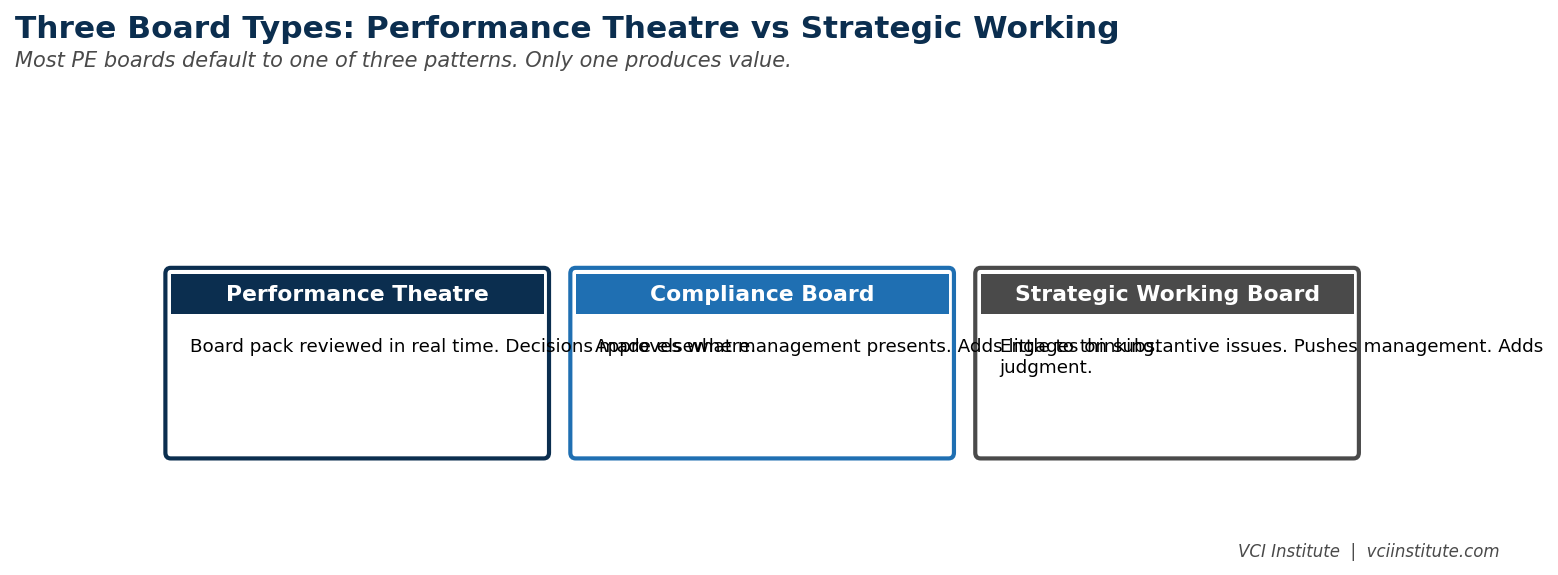
Most private equity portfolio company boards are performance theatre. The format is familiar. A monthly or quarterly meeting. A management presentation that tracks against the value creation plan. A discussion that ranges across operating issues at varying depths. A series of approvals that are mostly procedural. A handful of strategic conversations that arrive late in the agenda when bandwidth is depleted.
The format produces a board pack that LPs can be shown, a governance record that auditors can verify, and a sense among the directors that they have done their job. What it rarely produces is the kind of strategic counsel that materially shapes the value creation outcome of the deal. The board, in too many cases, is a forum that exists to be reported to rather than a forum that exists to add value.
The short answer
A private equity board has four functions: fiduciary oversight, performance review, strategic counsel, and networking. Most boards spend sixty to seventy percent of the meeting on performance review, which is the function with the fastest diminishing returns. The fix is three moves. Push fiduciary oversight into a pre-read handled in twenty minutes. Focus performance review on exceptions rather than a full walkthrough. Designate one or two strategic topics per meeting with prepared discussion papers, and give them the majority of the time.
This is not a structural inevitability. Boards in private equity portfolios can be designed to function as strategic counsel rather than as performance theatre. The redesign is straightforward in principle and unfamiliar in practice, which is why most portfolio companies operate with the default model rather than the higher leverage alternative.
What Boards Are Actually For
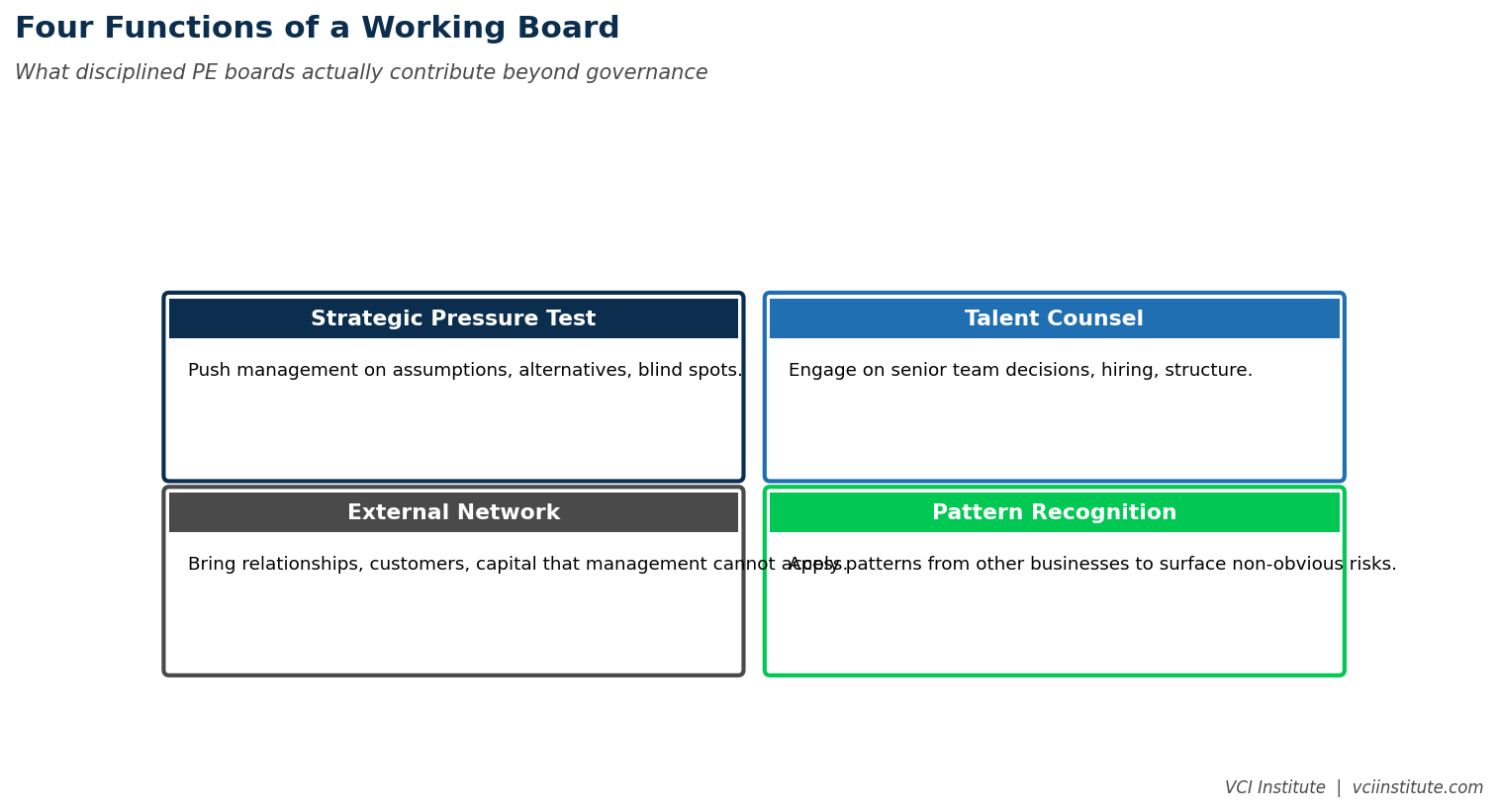
The four functions a private equity portfolio company board can usefully perform are distinct from each other and require different design choices.
The first function is fiduciary oversight. The board has legal and structural responsibilities to monitor the financial health of the company, the performance of management, the integrity of reporting, and compliance with the company's obligations. This function is necessary but should not consume the majority of board time. It is largely procedural and can be addressed efficiently when management has produced clean reporting in advance. Whether that is possible at all depends on whether the company agrees with itself on its own numbers, which is the problem the single source of truth audit is designed to solve.
The second function is performance review. The board reviews progress against the value creation plan, identifies gaps, and works with management to address them. This function is the one that most boards default to, often consuming sixty to seventy percent of meeting time. It is genuinely important but produces diminishing returns as the meeting progresses, because the depth of review possible in a board meeting is limited by the time available and the bandwidth of directors who are not in the business daily.
The third function is strategic counsel. The board engages with management on the major strategic questions facing the business. New market entry. Major M and A. Significant pricing or product decisions. Capital allocation between organic growth and acquisitions. The board's role is to be a thoughtful counterpart to management, bringing perspective, experience, and challenge. This function is the one that most boards underperform on, partly because they have spent the meeting time on performance review and partly because they have not been designed for strategic counsel. Decisions such as whether to run a dividend recapitalisation belong squarely in this category and are frequently handled as an approval rather than as a discussion.
The fourth function is networking and connection. The board provides access to relationships, customer introductions, talent referrals, and industry insight that the management team would not otherwise have. This function is highly leveraged when it works but is rarely structured. Most boards rely on directors to provide these connections informally, and most directors do so unevenly.
A board that is designed to perform all four functions, with deliberate attention to which time is allocated to each, produces meaningfully more value than a board that defaults to performance review with the other three functions tucked around the edges.
The Composition Question
Board composition is the single biggest determinant of whether the four functions can be performed well. The default composition in many private equity portfolio companies is dominated by deal team representatives, with one or two operating partners and a single independent director. This composition optimizes for ownership oversight and underweights strategic counsel and networking.
The alternative composition, increasingly used by sponsors that have thought hard about board design, looks like this. The board has five to seven members. Two seats are held by deal team and operating partner representatives, sufficient for ownership oversight. One seat is held by the CEO or, in some cases, the CFO. Two to three seats are held by independent directors who bring specific expertise relevant to the value creation plan, such as a former CEO of a similar business, a customer side senior executive, a domain expert in the relevant technology or market, or a former operating executive in an adjacent industry. One seat may be held by a strategic outsider who provides networking and connection value rather than direct expertise.
The independent directors are not selected for prestige or general management background. They are selected for specific contribution to the value creation thesis. A board with three independent directors who can each meaningfully advance one workstream of the value creation plan produces more strategic counsel than a board with three independent directors who are general advisors.
The selection process is more demanding than the standard board search. Sponsors that are deliberate about this often run a small dedicated process for each independent director seat, with a brief that specifies what the director is expected to contribute, references that test the contribution rather than the credentials, and a one-year evaluation that confirms the contribution is materializing.
The Meeting Design
The meeting itself can be redesigned to produce the four functions more reliably.
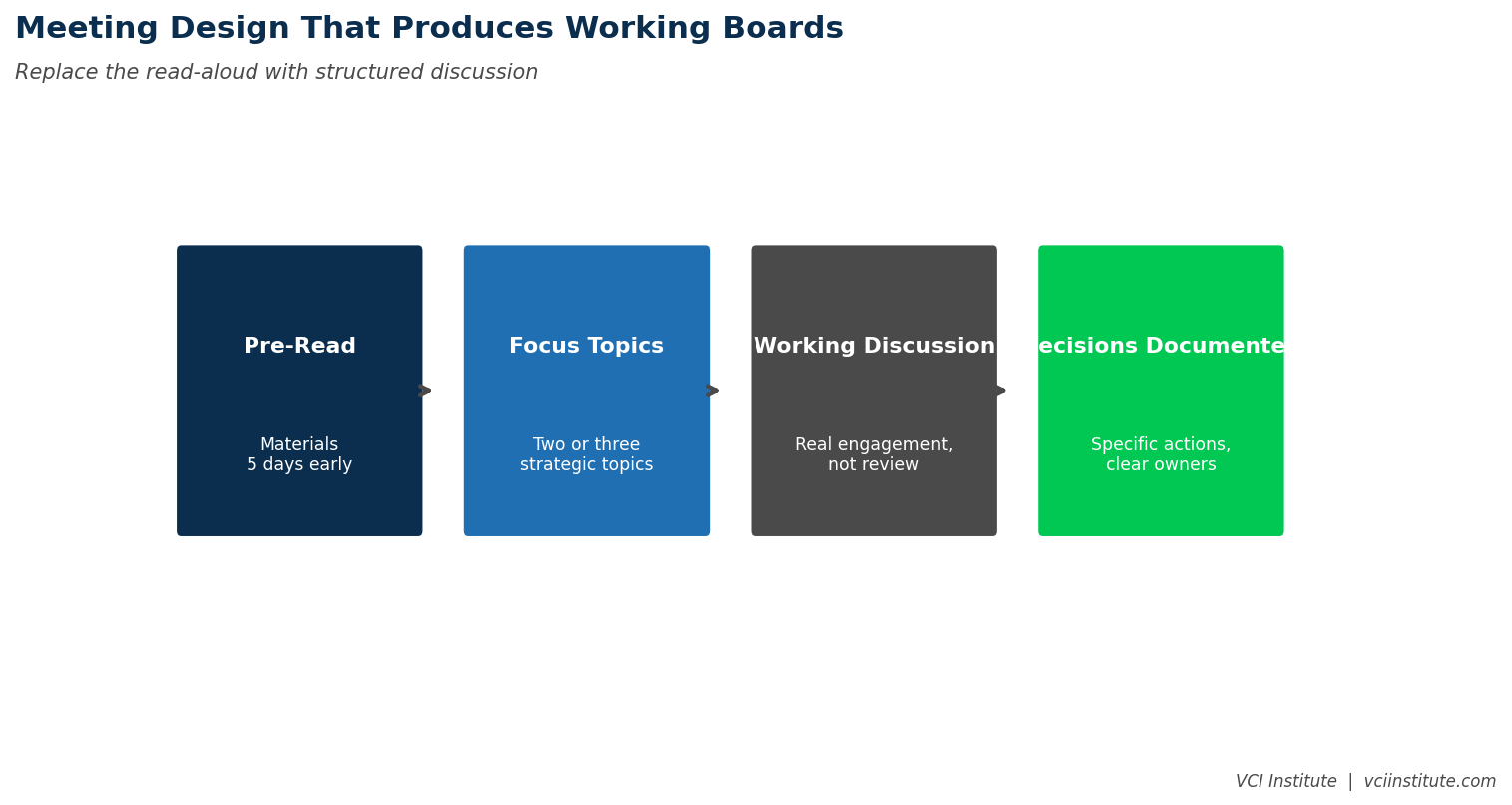
The fiduciary oversight function can be addressed through a written board pack that arrives in advance and is acknowledged at the start of the meeting rather than walked through. The financial reporting, the compliance reporting, and the routine approvals are presented in writing and addressed in fifteen to twenty minutes at the start, with directors having read the materials beforehand. This frees ninety percent of the meeting for higher value functions.
The performance review function can be focused on exceptions and trajectory rather than on a full walk through. Management presents the two or three areas where performance is materially different from plan, the underlying drivers, and the corrective actions being taken. The board engages with these specific issues rather than reviewing all areas of the business at uniform depth.
The strategic counsel function gets the largest share of meeting time. Each meeting has one or two designated strategic topics, identified in advance, where management has prepared a structured discussion paper and the board engages substantively. The discussion is not a presentation followed by questions. It is a working conversation in which the board's experience and perspective is genuinely solicited and used.
The networking and connection function is addressed through structured asks. At the start of the meeting, management presents the specific introductions, referrals, or insights it would value from the board. Directors respond either at the meeting or follow up afterward. This makes the networking function explicit and trackable rather than dependent on directors volunteering connections informally.
A meeting designed around these four functions feels different from a typical board meeting. Less reporting, more conversation. Less defensive, more constructive. Less performance, more substance. Directors who have served on both kinds of boards report that the redesigned meetings are more demanding but more rewarding, and management teams report that they take more value from the redesigned meetings as well.
What Operating Partners Should Press For
Operating partners are usually well positioned to influence board design, because they often serve as directors, work closely with the CEO who interacts with the board, and engage with the deal partner who often has formal authority over board composition.
Three specific moves are worth pressing for in any new portfolio company.
The first move is to redesign the board pack format. The pack should be readable in forty-five minutes. It should be organized around the four functions rather than around departmental reports. It should include a section on strategic discussion topics that the board is being asked to engage with, with management's recommendation and the open questions where input is being sought. This is usually work the CFO leads, which is one more reason the CFO upgrade question deserves an early answer.
The second move is to upgrade the independent director composition. If the existing directors are weak, replace one per year. If the seats have not yet been filled, fill them deliberately rather than expediently. Independent directors take eighteen months to become genuinely productive, so the recruitment timing matters.
The third move is to introduce the strategic topic discipline. Each board meeting has one or two designated strategic topics, identified in advance, with prepared discussion materials. The discipline forces the board into substantive engagement rather than reactive review and produces conversations that materially advance the value creation plan.
These three moves can be executed within the first six months of ownership. They cost very little in dollars and produce meaningful value over the hold period.
What Boards Cannot Do
It is also worth being honest about what boards cannot do, regardless of how well they are designed. Boards cannot run the business. They meet too infrequently and have too little context. Boards cannot replace operating partner engagement. Operating partners spend much more time inside the business and have a depth of context that directors will never match. Boards cannot resolve operating partner and CEO disagreements that have not first been worked at the operating partner and CEO level. Bringing fundamentally bilateral issues to the board damages the working relationship without resolving the issue. This is precisely what the operating partner and CEO compact exists to prevent, by defining in advance which disagreements belong at the board and which do not.
The boundary between what the board can usefully address and what it cannot is part of the discipline of using boards well. Sponsors that respect the boundary find that their boards add real value. Sponsors that ignore the boundary either underuse their boards on the things they can do or overuse them on things they cannot, both of which produce disappointment.
The Board as a Window into the Sponsor
LPs and prospective acquirers form views about sponsors partly from how their boards function. A portfolio company board that runs as substantive strategic counsel signals that the sponsor takes governance seriously. A portfolio company board that runs as performance theatre signals that the sponsor treats governance as compliance. The signal travels, often quietly, through the network of independent directors who serve on multiple boards and discuss what they have seen.
Sponsors that build a reputation for strong board governance attract stronger independent directors. Stronger independent directors produce better board functioning. Better board functioning produces better strategic outcomes. The compounding works in both directions.
The investment in board redesign is, in this sense, an investment in the sponsor's own institutional reputation as much as it is an investment in the specific portfolio company. Operating partners who understand this make the investment deliberately. Operating partners who view boards as an inherited governance burden tend to inherit boards that perform as governance burdens.
The redesign is not difficult. The discipline to do it consistently across the portfolio is. Sponsors that achieve the discipline find that their boards become a real asset of the firm. Those that do not find that their boards remain what most boards have always been, a meeting that everyone attends, few enjoy, and even fewer find changes how the business actually runs.
COPPE Level 1
The language a sponsor expects in a board pack
Board governance is one part of the operating partner craft. COPPE Level 1 covers the value creation levers, the hundred day structure, and the governance relationship with a portfolio company chief executive. Twelve lessons, each with a written lesson, a Visual Companion, an audiocast and a videocast.
VCI Institute in collaboration with Mohamad Chahine
Published 27 August 2026
Related reading from the VCI Institute
The Operating Partner and CEO Compact
Why it has to be written, and which disagreements should never reach the board.
The CFO Upgrade Question
The finance leadership decision that determines whether the board pack is worth reading.
The Single Source of Truth Audit
Data hygiene before dashboards, because fiduciary oversight is only as fast as the reporting is clean.
About the VCI Institute
The VCI Institute is a nonprofit dedicated to building practical capability and shared standards for value creation in private equity. The Institute publishes operator-grade frameworks and runs certification programmes for operating partners, portfolio company executives, and value creation analysts. You can see what each programme actually covers before deciding. Analysis published here draws on the Institute's certification curricula and on structured review of mid-market transaction patterns rather than on any single proprietary dataset. Where a figure is directional rather than measured, it is described as such.
Further material is available in the Institute's Insights library and its free resource library of templates, checklists, and case snapshots.
© 2026 VCI Institute. All rights reserved. No part of this article may be reproduced or transmitted in any form without prior written permission of the VCI Institute.
We have many great affordable courses waiting for you!
Stay connected with news and updates!
Join our mailing list to receive the latest news and updates from our team.
Don't worry, your information will not be shared.
We hate SPAM. We will never sell your information, for any reason.


 Practice private equity like a pilot trains