Founder, Hire, Incumbent: The Three Operators PE Underwrites
Sep 21, 2026
Every PE-backed CEO is one of three people, and the difference matters more than tenure, industry, or pedigree.
There is the founder, who built the company and stayed.
There is the hire, who was recruited to professionalize it.
There is the incumbent, who was already there and inherited the new owners.
The short answer
Founders protect. Hires professionalise. Incumbents preserve. Each has a muscle memory that produces a predictable failure mode under sponsor ownership, and none of the three is right by default. The founder's failure mode is sentimental, protecting what defines them. The hire's is over-application, installing systems for problems the company does not have. The incumbent's is preservation, defaulting to continuity when asked for change. The diligence question is not whether the CEO is good. It is which archetype they are, and whether the thesis needs the strengths that archetype actually delivers.
Each archetype walks into the first board meeting confident. Each archetype reads the room differently. Each archetype has a muscle memory that produces a predictable failure mode under PE ownership. None of the three is right by default, and the boards that figure that out early save themselves twelve months of the wrong conversation.
This is not a personality framework. It is a diagnostic. The three archetypes have different value creation profiles, different sponsor expectation maps, and different pre-existing strengths. Treating them as interchangeable is one of the most common diligence errors we see, and it shows up later as a CEO transition that the deal team did not plan for.
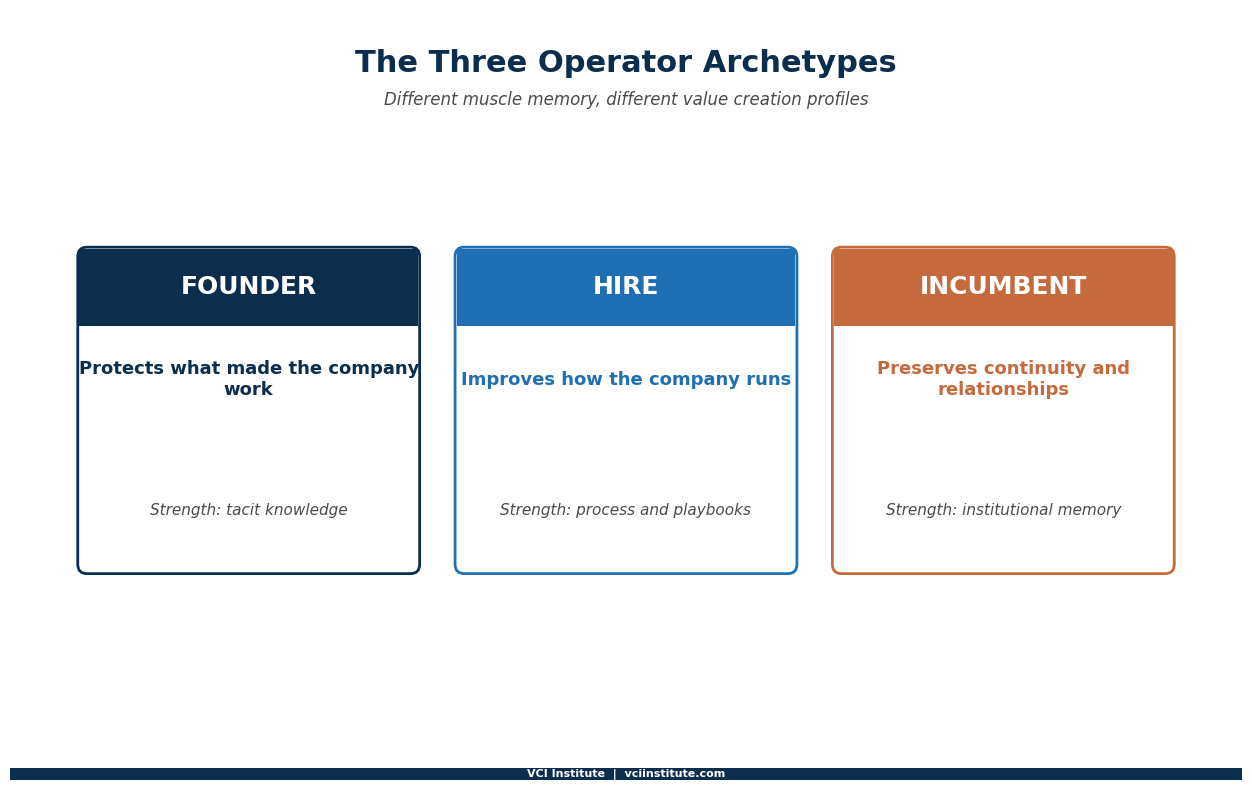
The founder protects what made the company work.
The founder's strength is unambiguous. They built it. They know which customer phone calls matter. They know which two engineers carry the product. They know which competitor will follow them on price and which one will not. That tacit knowledge is genuinely irreplaceable in years one and two. A founder who is engaged and aligned is the highest leverage operator a fund can have.
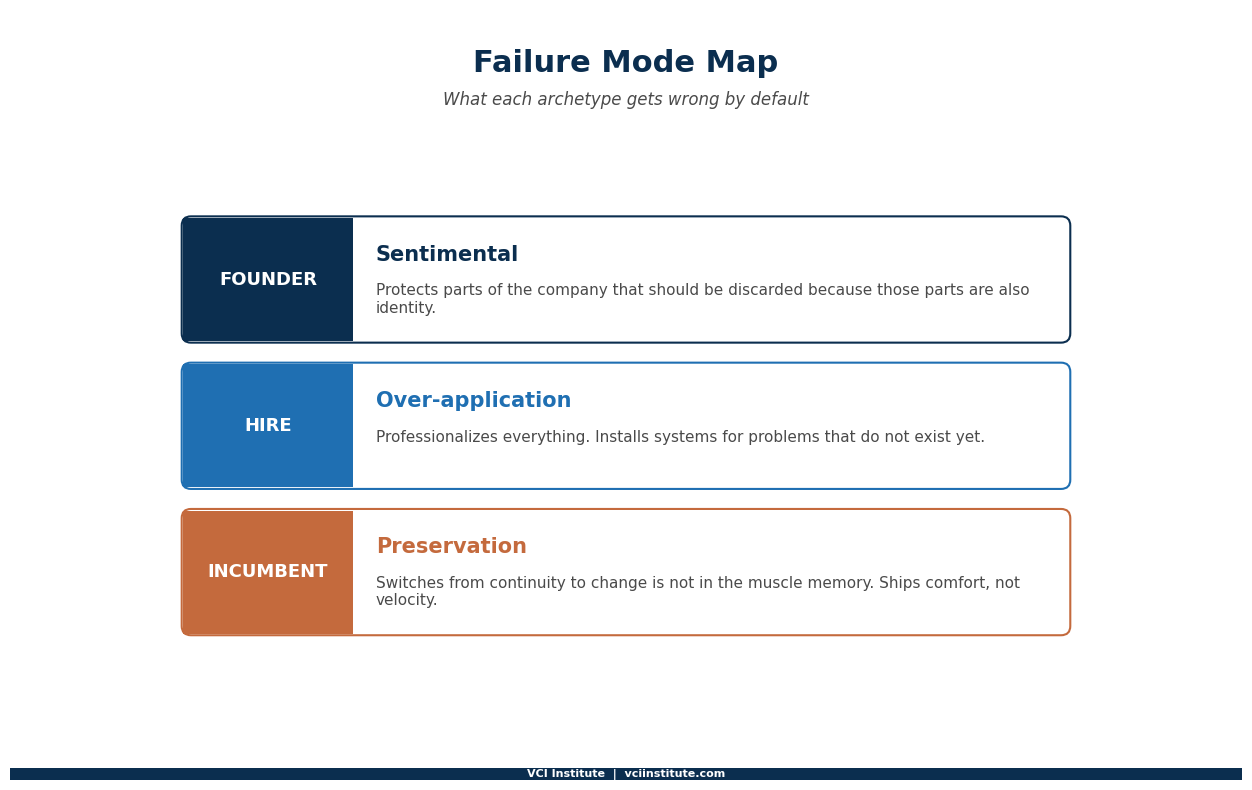
The founder's failure mode is sentimental. They protect the parts of the company that should be discarded because those parts are also part of how the founder defines themselves. The customer who has been there since year one and now consumes a quarter of the sales team's time. The product line that defined the brand and now loses money. The cousin in the warehouse. None of these are operating decisions for the founder. They are identity decisions.
What sponsors should expect from a founder operator is sharp judgment on what is real, slow movement on what is sentimental, and an honest answer to one question. Are you here to grow the business or to protect it? Both answers are legitimate. Most founders do not know which one they have given until eighteen months in. The related risk is on the other side of the table, where the sponsor's own professionalisation instinct produces the founder speed tax and removes the very thing that was paid for.
The hire improves how the company runs.
The hire's strength is process. They have run a function or a business at scale. They know what good looks like. They have the playbooks. They have the credibility with the deal team because they speak the dialect. The first VCP they write usually reads like a textbook, in the good sense.
The hire's failure mode is over-application. They were hired to professionalize the company, so they professionalize it. All of it. They install systems for problems the company does not have yet. They hire the team they ran at the last place. They mistake structure for execution. By month nine, the company has more meetings, more dashboards, and the same EBITDA, and the founder, if there is one still around, is quietly furious. An operating maturity diagnostic run in the first fortnight is the cheapest available correction, because it tells the hire what the company can absorb rather than what the last company needed.
What sponsors should expect from a hire operator is fast operating apparatus, slower contextual judgment, and a calibration question that has to get answered explicitly. Which parts of how this company runs should I leave alone? Hires who treat the company as a corporate retrofit project produce a known failure pattern. Hires who treat the company as an existing system to be selectively upgraded produce different outcomes.
The incumbent preserves continuity and relationships.
The incumbent's strength is institutional memory. They know where the bodies are. They know which customer was a handshake deal. They know why the manufacturing line in Tennessee was set up the way it was, and they know it cannot just be moved. They are the only operator of the three with full operational tacit knowledge plus existing relationships across the company.
The incumbent's failure mode is preservation. They were the lieutenant who kept things working under the founder. They know how to keep things working. They do not always know how to change things, because their authority was lateral, not directional. When PE arrives, the incumbent is asked to switch from continuity to change, and the muscle memory does not switch. They ship comfort, when the deal team is asking for velocity.
What sponsors should expect from an incumbent operator is strong institutional grip, weak change appetite, and a hard question that the deal team has to answer before close. Are we backing this person to lead the change, or are we backing this person to support a leader who will? Both can work. Confusing the two destroys eighteen months.
Each archetype carries a value creation profile.
The founder's value creation profile is asymmetric. Where they engage, they move mountains. Where they do not, the company does not move at all. The deal team's job is to map the asymmetry early and not to mistake silence in one area for capacity in another.
The hire's value creation profile is broad and shallow. They will move several levers at once, modestly. The deal team's job is to insist on sequencing. Three levers moved fully will create more value than seven levers moved partially. Hires resist sequencing because moving everything feels like progress. The discipline that fixes this is tracing every initiative back to the underwriting logic, which is the work described in the Thesis Operating System.
The incumbent's value creation profile is operating efficiency, with a ceiling. The incumbent will tighten what they own, sometimes dramatically. The incumbent will rarely break new ground. The deal team's job is to be honest about whether the thesis requires breaking new ground. If it does, the incumbent is not the answer. If it does not, the incumbent might be the cleanest answer.
Sponsor expectations should be calibrated to the archetype, not to a generic CEO playbook.
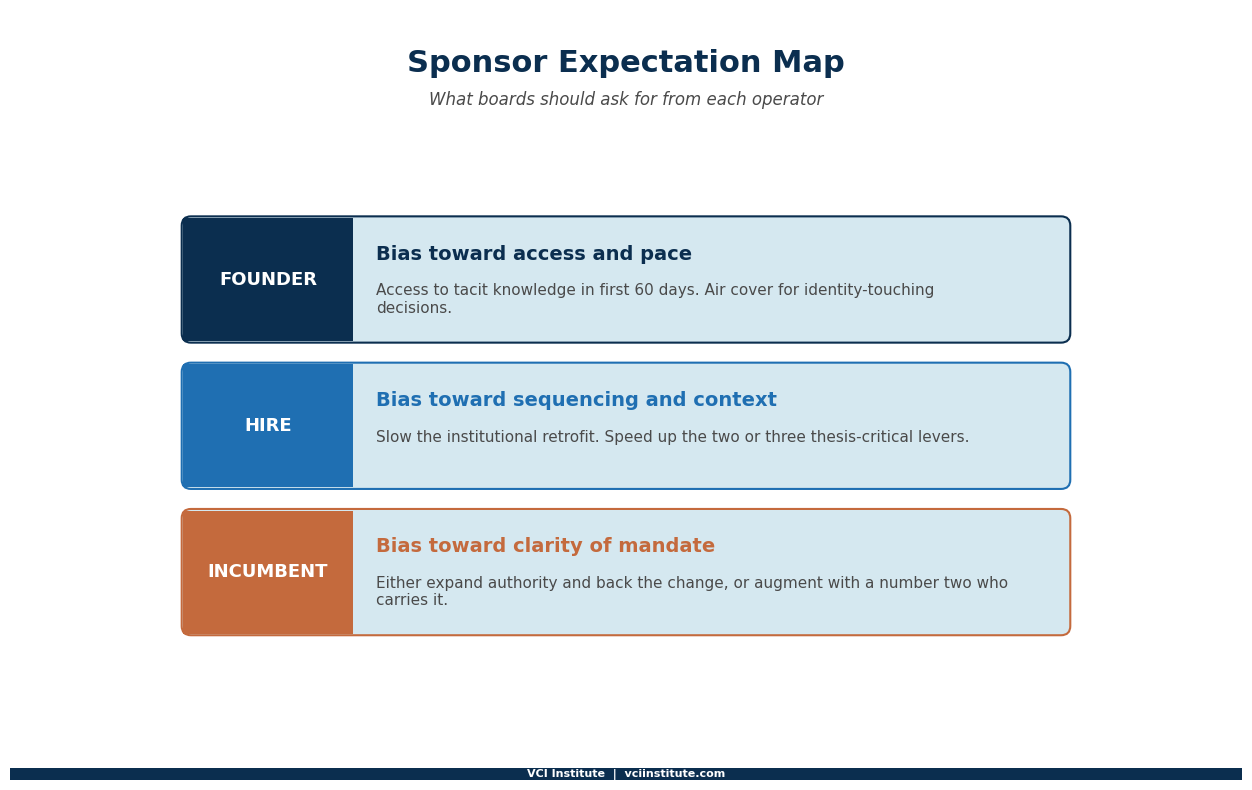
For founders, the sponsor's expectation should bias toward access and pace. Access to the founder's tacit knowledge in the first sixty days. Pace on the strategic decisions the founder is most likely to defer. The board's job is to give the founder explicit air cover for the decisions that touch identity. Otherwise those decisions become permanent stalls.
For hires, the sponsor's expectation should bias toward sequencing and context. Slow the operator down on the institutional retrofit. Speed the operator up on the two or three thesis-critical levers. Insist that the first sixty days are spent learning the system before changing it. Hires who are pulled into context-setting early produce stronger second halves. This has to be reconciled against the reality of the 45-day math, where the grace window is spent building apparatus rather than delivering output, which is a genuinely different instruction from slow down.
For incumbents, the sponsor's expectation should bias toward clarity of mandate. Either expand the incumbent's authority and back them as the change agent, or augment them with a number two who carries the change mandate. Leaving the incumbent in ambiguity is the most expensive option. They will default to preservation, because that is what their muscle memory does under uncertainty. Whichever route is chosen, it belongs in writing, which is the argument for the operating partner and CEO compact.
The diligence question we keep returning to is not whether a CEO is good. It is which of the three operators they are, what their muscle memory will do under PE ownership, and whether the thesis requires the strengths their archetype actually delivers.
The board that asks that question on day one buys eighteen months. The board that does not, spends them.
The most expensive line item in private equity is not interest expense. It is the eighteen months between when a deal team realizes they have the wrong operator and when they replace them. The three-archetype lens is the cheapest way to compress that line item before it shows up in the actuals.
COPPE Level 1
If you are the hire, this is the context you were not given
Most operators arrive from corporate roles with playbooks that do not translate. COPPE Level 1 covers what changes under sponsor ownership: the value creation levers, the hundred day structure, the governance relationship with a portfolio company chief executive, and the language a sponsor expects in a board pack. Twelve lessons, each with a written lesson, a Visual Companion, an audiocast and a videocast.
VCI Institute in collaboration with Mohamad Chahine
Published 21 September 2026
Related reading from the VCI Institute
The 45-Day Math
Why PE onboarding is shorter than you think, and what each archetype should be building in the grace window.
The Founder Speed Tax
When professionalization kills the business you bought, and the risk sitting on the sponsor's side of the table.
The CFO Upgrade Question
The same invest, augment, or replace decision, applied one seat over.
About the VCI Institute
The VCI Institute is a nonprofit dedicated to building practical capability and shared standards for value creation in private equity. The Institute publishes operator-grade frameworks and runs certification programmes for operating partners, portfolio company executives, and value creation analysts. You can see what each programme actually covers before deciding. Analysis published here draws on the Institute's certification curricula and on structured review of mid-market transaction patterns rather than on any single proprietary dataset. Where a figure is directional rather than measured, it is described as such.
Further material is available in the Institute's Insights library and its free resource library of templates, checklists, and case snapshots.
© 2026 VCI Institute. All rights reserved. The frameworks, terminology, and analysis presented in this article are the intellectual property of the VCI Institute. Reproduction or derivative use without written permission is prohibited. Citation with proper attribution is welcomed.
We have many great affordable courses waiting for you!
Stay connected with news and updates!
Join our mailing list to receive the latest news and updates from our team.
Don't worry, your information will not be shared.
We hate SPAM. We will never sell your information, for any reason.

 Practice private equity like a pilot trains